

A Rate Cut Followed by a Likely Pause
The Fed signaled it is now entering a pause phase, projecting only one more potential rate cut in 2026. Policymakers remain divided, but Powell emphasized that interest rates have now returned to the upper end of "neutral" — a range that neither stimulates nor restricts economic activity.
The Federal Reserve delivered a widely anticipated 25-basis-point interest rate cut, reducing the federal funds target range to 3.5%–3.75%. While markets expected the move, the tone from Fed Chair Jerome Powell and the updated economic outlook offers important guidance for commercial real estate investors, landlords, and occupiers heading into 2026.
Below, Landair breaks down the decision — and what it means for your portfolio and strategy.
Implications for CRE
- Stabilization in borrowing costs for acquisitions and refinancing
- Improved clarity around pricing and cap rate expectations
- Potential unlocking of transaction activity as buyers and sellers regain confidence
For the first time in over two years, the debt markets are showing early signs of predictability — a welcome shift for dealmakers.
Payroll Data May Overstate Economic Strength
A key takeaway from Powell’s press conference:
The Fed believes the U.S. job market may be weaker than headline numbers suggest.
Official payroll reports show gains of about 40,000 jobs per month, but Powell noted that the data may be overstated by roughly 60,000, implying the economy could actually be experiencing slight job losses.
Why This Matters for Commercial Real Estate
- Office demand may remain soft as hiring plans slow
- Retail spending momentum could moderate
- Industrial leasing likely remains solid but with slower expansion
- Multifamily absorption could flatten in metros with large new supply pipelines
While this isn’t recessionary, it reflects a cooling environment — one where disciplined underwriting matters.
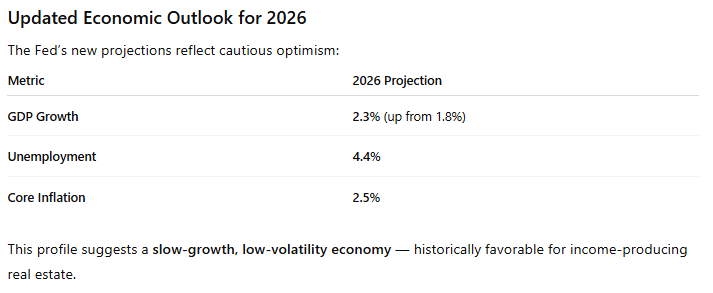
Inflation Is Less of a Threat Going Forward
Powell downplayed ongoing inflation risks, attributing recent price pressure primarily to tariffs, which he views as temporary, one-time adjustments. As tariff effects fade, the Fed expects inflation to continue easing toward the 2% target.
What Lower Inflation Means for CRE
- More stable interest rate swaps and hedging costs
- Greater visibility for long-term financing structures
- Reduced volatility in construction budgets and materials pricing
CRE investors thrive on predictability — and this environment is slowly moving back in that direction.
Capital Markets Still Sending Mixed Signals
Even with Fed rate cuts, the 10-year Treasury yield remains near 4.15%, influenced by global debt concerns and tighter expectations abroad.
Takeaway for CRE investors
- Permanent loan rates will remain higher than pre-2022 norms
- Bridge financing and alternative capital sources remain competitive
- Lender standards will stay conservative, especially on transitional assets
Overall, capital markets are more stable — but not necessarily cheap.
2026 CRE Outlook: Landair’s Perspective
1. Investment Sales May Rebound
Stabilizing rates reduce the pricing gap between buyers and sellers, improving transaction velocity.
2. Selective Distress Creates Opportunity
Refinancing challenges will continue in:
- Office
- Hospitality
- Older retail assets
This creates windows for value-add and opportunistic investors.
3. Industrial & Data Centers Continue to Lead
AI infrastructure growth and high-demand logistics corridors remain fundamental drivers.
4. Office Tenants Keep the Upper Hand
With tepid hiring, tenants will continue to negotiate aggressively on:
- Concessions
- Tenant improvement packages
- Lease length flexibility
5. Multifamily Remains Strong but Normalizing
Rents remain stable, with growth varying by market and supply pipeline.
Conclusion: A More Navigable Market Ahead
While uncertainties remain, the Fed’s December move represents a shift toward stability after years of rapid rate adjustments and pricing volatility. Commercial real estate is entering an environment where:
- Capital costs are clearer
- Inflation is receding
- Economic growth is steady, not overheated
- Opportunities exist for disciplined investors
At Landair, we help clients interpret these macro shifts and execute strategies aligned with the evolving market landscape.
Want a Customized 2026 Real Estate Outlook?
Whether you’re evaluating an acquisition, planning a refinance, or reassessing space needs, Landair provides tailored advisory to help clients navigate shifting market conditions with confidence.
Contact our team for a personalized consultation.
Adapted from Investor’s Business Daily (IBD)